
Painting walls correctly
The walls in living rooms should be repainted every few years. Wall paint is affected and changes by the sun, odors, and other particles in the air. That's why you should renew the paint every now and then. We explain what you need to pay attention to when painting walls.
Once it has been decided whether the walls should be painted white or whether a different shade should be preferred, the painting preparations begin. The more careful the preparatory work, the better the result.
If it's not enough for you to just repaint your room, we'll show you how to plaster your walls.
Painting walls – this is important
- Painting walls - material and tools
- The right preparation for painting walls
- This is what wall painting is all about
- Painting walls - step by step
- Special tool for painting walls
- How to paint the walls around a radiator
Painting walls – materials and tools
In order to be able to paint walls, you need basic equipment. This consists of
 Affiliate Links
Paint Tub
10,90 € |
 Affiliate Links
Painter's grille
8,99 € |
 Affiliate Links
Painter Set
€17.99 |
 Affiliate Links
Corner Brush
22,90 € |
 Affiliate Links
Crepe masking tape
9,98 € |
 Affiliate Links
Cover film
€13.29 |
Did you know that wall colours influence the effect of a room? You can read here how and how you can use it sensibly.
In addition to the right color, the right tools are also an indispensable prerequisite for a successful work. A paint roller for even paint application and a scraper grid are indispensable. The size of the roll depends on the size and accessibility of the wall surface.
For inaccessible places, for example behind radiators, there are castors with a small diameter and extra long handle. There are also special castors for a contrasting transition between wall and ceiling or for the corners.
Cheap products made of plush or vestan are not recommended, paint rollers based on polyamide or polyacrylic are better. Lambskin rolls are expensive, but they are at the top of the list in terms of spreading. Always wet the roll before the first coat, then the fibers will open and the paint will be absorbed more easily.

For painting high walls or ceilings, the use of a Telescopic pole* so that repeated ladder climbing is unnecessary. However, the effort required when stroking with the rod is greater. Corners can be cut very well with long-stemmed, angled Radiator brushes*but some also draw the special Corner Roller* before.
 Affiliate Links
Telescopic rod
€11.06 |
 Affiliate Links
Radiator brushes
8,76 € |
 Affiliate Links
Corner Roller
€13.88 |
Before painting – the right preparation
- Before painting, empty the room as completely as possible or layer remaining objects in the middle of the room to cover them well with foil, as well as the floor
- Then tape skirting boards, window sills, door frames and so on with masking tape
- Remove all lamps
- Remove any nails or screws
- If holes are to be reused later, insert a match to mark them
Do not hastily reach for a roller and brush, but inspect the surfaces to be painted for damage. Small cracks and (dowel) holes must be filled and, if necessary, sanded smooth after drying.
If new wallpaper or newly plastered walls are to be painted, there should be no problems with the substrate.
It can look different if old paint is present. In this case, the old paint must first be checked for its adhesion. To do this, follow these steps:
- Paint over a small test area. Poor substrate can cause the paint to chalk or darken when dabbed with a wet finger.
- Do the adhesive tape test: To do this, press a strip of crepe tape against the wall. If you now peel it off again and paint residues stick to it, the substrate cannot be painted over.

In such a case, it is advisable to wash the wall and treat it with deep primer. Deep Ground* penetrates into the loose layer of paint and the top layer of plaster and forms a solid layer from it.

4,95 €
Today, interior walls are painted exclusively with ready-made wall paints (emulsion paints), which are available in various qualities in DIY stores or paint stores. How much area you can paint with a paint is usually written on the container. It is better to calculate a little more for rough surfaces. Mineral paints are particularly suitable for textured walls.
By the way, silicate paints ensure a particularly good indoor climate. You can read here what you need to consider when using silicate paints.
This is what wall painting is all about
Generell gilt: Erst die Zimmerdecke streichen, dann die Wände. Und immer mit dem Lichteinfall vom Fenster weg arbeiten. Zunächst die Kanten mit Pinsel oder kleiner Rolle sorgfältig streichen, dann folgt mit großer Rolle (auf dem Teleskopstiel) der flächige Anstrich.
Vorsicht bei weißen Wänden: Darauf müssen Sie achten, wenn Sie Wände weiß streichen wollen!
- Die Farbe wird üblicherweise in Ecken und an Kanten sowie schwer zugänglichen Stellen mit dem Pinsel, auf Flächen mit der Farbrolle aufgetragen.
- Dabei sind langflorige Rollen besser für dünnflüssige Farben geeignet. Sie nehmen mehr davon auf und sind daher eher für grobporige Wände (Rauhputz) geeignet.
- Mit kurzflorigen Rollen lassen sich pastöse und feste Farben besser verarbeiten. Sie sind meistens kleiner und darum leichter in der Hand.
- Die gesamte Decke und einzelne Wandflächen sollten in einem Arbeitsgang gestrichen und Pausen vermieden werden, da ansonsten später Ansätze sichtbar sein können: Das heißt, immer "nass in nass" arbeiten und die Rolle so lange am Abstreifgitter abrollen, bis nichts mehr tropft.
- Beginnen Sie auch beim Streichen der Wände mit den Ecken und an der Fensterseite.
- Folgen Sie dem Licht in den Raum. Um eine möglichst gleichmäßige Fläche zu erzeugen, ist es ratsam, sich etwa 1 m2 große Wandabschnitte vorzunehmen und diese mit "M"- oder "W"-Bewegungen zu füllen, dann den Feinstrich (das "Verschlichten") von oben nach unten ausführen.
Wenn Sie mehrfarbig arbeiten und beispielsweise eine Wand im Raum andersfarbig absetzen wollen, muss die entsprechende Fläche präzise abgeklebt werden. Am besten eignet sich hierfür ein flexibles Malerkrepp*.
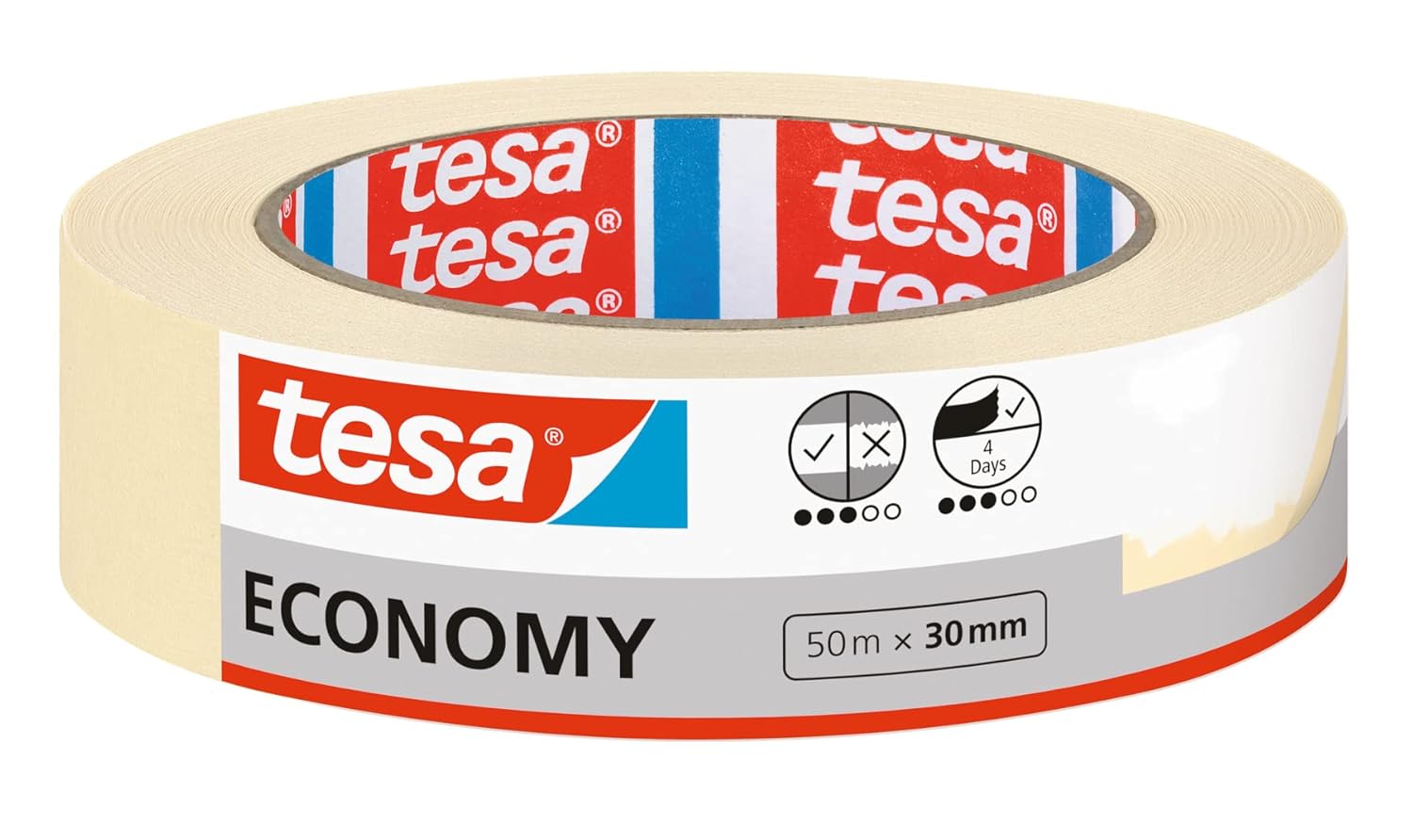
4,56 €
Damit Sie Ihre Wände richtig streichen können, finden Sie hier die bestbewerteten Leitern:
Anzeige
Painting correctly -step by step
Step 1/14: Lay out the cover film
Cover film with self-adhesive edge can be unfolded after bribing and thus covers almost the entire floor.
Step 2/14: Tape off the light switch
Problem areas such as sockets and light switches can be protected from paint with tesa crepe instead of dismantling them.
Step 3/14: Sealing gaps
Door frames are also masked with painter's tape. Fill large gaps at the transition to the wall with acrylic spatula from the tube.
Step 4/14: Cover radiators
The cover film with the self-adhesive edge is also suitable for covering radiators. To do this, turn off the radiator.

Step 5/14: Cleaning the wall
Basically, dirty walls must be cleaned to make them dust- and grease-free. To do this, dilute a conventional kitchen cleaning agent in warm water and remove the dirt and grease with a sponge and brush.
Step 6/14: Paint rollers and pile length
The substrate and colour determine the length of the pile. Long-pile for coarse wall structures, medium for smooth walls, short for solid colours.
Step 7/14: Stir through the paint
Before the new paint is processed, it must be stirred well, because the heavier pigments tend to settle on the floor.
Step 8/14: Unwind the roller well
In order to achieve an even application of paint, the roll must be rolled out after immersion on the smear grid.
Step 9/14: Ink tray for dosing
The paint tray has proven to be very practical, in which you can dose the paint application on the lambskin roller very precisely.
Step 10/14: Paint the edge with a brush
Use a radiator brush to trim the edge (trimmed edge) to the ceiling. To do this, do not dip the brush too deeply into the paint.

Step 11/14: Corner Roller
This roller is a great help: The special "corner roller" has a cone-shaped roller and is therefore suitable for 90° internal angles.
Step 12/14: Swipe from bottom to top
The soaked roll is first guided from bottom to top. This way, the paint doesn't spill on the floor right away.
Step 13/14: Distribute paint crosswise
The thickly applied coat of paint must now be spread crosswise, then immediately set the next stroke and spread it crosswise (wet in wet).
Step 14/14: Draw lengths vertically
After the criss-cross distribution, the paint is traced vertically from top to bottom with straight overlapping strips.
Here you can find out how to paint windows correctly!
Special toolsfor painting walls
- The Corner Roller* was designed for the 90 degree inner corner.
- The Radiator roller* is a classic among the special roles.
- Less well-known is the paint spatschen, which is ideal for inaccessible places. A velour bag is pushed onto the metal plate and knotted. Combined with the flexible temple, it is unbeatable.
How to paintaround a radiator
It is not so easy to paint behind the radiator. But with the right technology, it works.
Step 1/4: Tip: Wrap paper around pipe
There are always problems behind the radiator. A tip to avoid smearing the pipes: fold a sheet of paper around the pipe and paint behind it with the radiator brush.
Step 2/4: Radiator roller
The radiator roller fits exactly into the distance to the wall, but also lubricates the radiator full here. Hang a sheet of masking paper behind it and the danger is averted.
Step 3/4: Practical: The Slipper
The pad is equipped with a replaceable fleece cushion. Due to the flat construction, it fits into any narrow niche. The special bracket can be bent in all directions.
Step 4/4: Paint pat in use
Here you can see this practical paint slap in action. All the special tools shown here are available from well-stocked paint retailers. Manufacturer: Friess GmbH
To illustrate this, a video on how to paint the walls
Painting walls correctly is not difficult. However, there is more to it than just buying a bucket of paint and a brush. Preparatory work often seems annoying or even unnecessary - but it is not. If you value a particularly good result, you should not miss out on it under any circumstances.
Once the walls have been spruced up, lamps and the like can also be reattached. Here we show you how to do this if you want to connect a lamp.
More articles on painting walls
- Painting dark walls white: This is how it works
- 7 tips for painting walls
- Painting textured walls correctly
Article updated on 24.10.2023
In this text, we use so-called affiliate links. Products marked with an asterisk () or the note "Affiliate Links" can be purchased. If the purchase is made, we receive a small commission. You can find out more about affiliates here.*

Posting Komentar